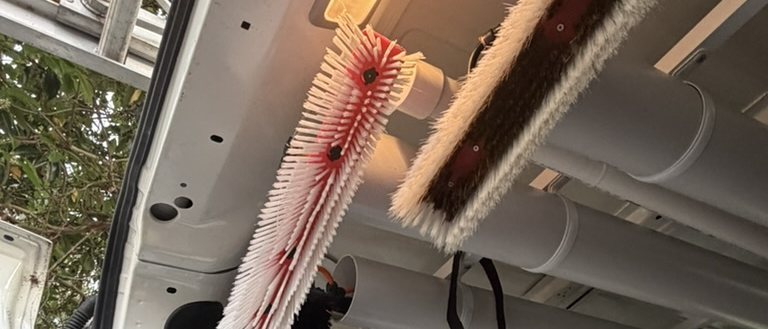
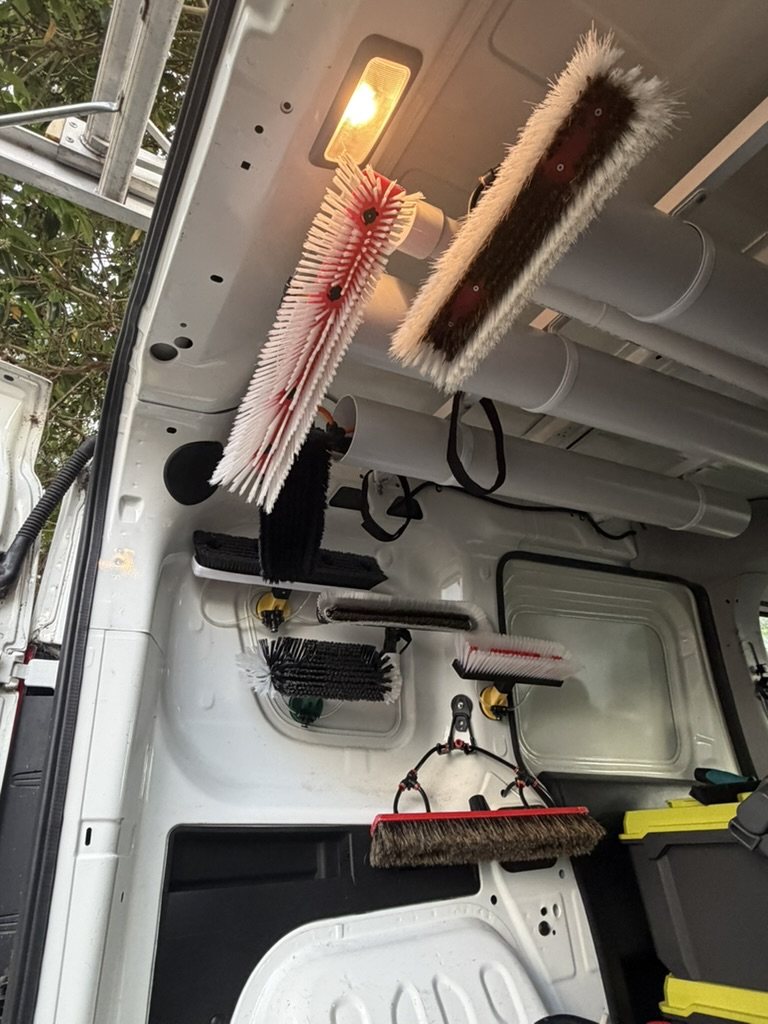
One brush can't do every job well. A bristle that's perfect for crusted salt on a beachfront window is far too harsh for 80-year-old timber frames, and a soft brush that's kind to old glass won't shift baked-on grime from a solar panel. So we carry a brush for each job, and we've invested a lot in getting that kit right.
Quick answer: the right window cleaning brush depends on the surface. Coastal Clear Windows, an owner-operated window cleaner on Sydney's Northern Beaches, uses a different brush head for each job:
| Job | Brush we use | Why |
|---|---|---|
| Older, heritage or tinted windows | Soft bristle | Gentle on old frames, putty, paint and coatings |
| Solar panels | Firmer brush made for panel glass | Lifts baked-on grime and bird droppings without harming the coating |
| Window sills up at height | Sill brush on a water-fed pole | Cleans upper-storey sills from the ground, no ladder |
| Salt build-up on coastal glass | Boar hair and nylon mix | Boar hair holds water to lift salt; nylon breaks up crust |
Why does the brush matter in window cleaning?
Most of our window cleaning is done with a water-fed pole and a pure-water system. The brush on the end of the pole does the actual work: it agitates the dirt so the pure water can rinse it away, leaving glass that dries spot-free. Get the brush wrong and you either leave dirt behind or put the glass, frames and seals under more stress than they need. Get it right and the finish is better, the job is quicker, and your windows are treated gently.
Which brush is best for older or heritage windows?
Plenty of homes on the Beaches have original timber windows, older glass, painted frames or putty that's been there for decades. These need a light touch. Our soft-bristle brushes lift dust, cobwebs and grime without catching on old paint, snagging seals or working loose glazing putty. We also reach for them on tinted or coated glass, where a gentle clean is the safest option.
What brush should you use to clean solar panels?
Solar panels collect a different kind of dirt: bird droppings, lichen, pollen and grime that bakes on under the sun. A soft window brush just glides over it. For panels we use a firmer brush made for panel glass, paired with pure water and no detergents or abrasive pads, so the grime comes off without harming the panel's coating. Clean panels make more power, which is the whole point. There's more on that in our guide to how dirty panels cost you money and on our solar panel cleaning page.
How do you clean window sills up at height?
Clean glass sitting above a dirty sill never looks finished. Sills collect dust, salt, bird droppings and the dirty water that runs off the glass, and on second and third storeys they're hard to reach. Our sill brushes are shaped to sit flat along the sill and fit on the end of the water-fed pole, so we can scrub and rinse sills up at height from the ground, without a ladder. The whole window gets done properly, not just the pane.
What is the best brush for salt build-up on coastal windows?
Salt is the big one on the Northern Beaches. On homes facing the water in places like Manly, Freshwater and Collaroy, sea spray leaves a film that dries hard and, if left, can etch the glass. For this we use a specialised brush that mixes natural boar hair with nylon. The boar hair holds plenty of water and stays soft on the glass, keeping the salt wet so it lifts away. The nylon gives the brush enough bite to break up crusted salt. Together they shift salt that a standard brush would smear around.
Why we invest in specialist window cleaning gear
Buying one brush and using it for everything would be cheaper. But the right equipment gives a better finish, protects your windows and panels, and lets us work safely from the ground on most two-storey homes. When we arrive, we look at the glass, the frames and how exposed the house is to the weather, then choose the brush to suit. It's a small detail, and it's one of the reasons our windows stay clearer for longer.
Not sure what your windows need? Get an instant quote or call Graeme on 0492 005 501 and we'll tell you how we'd approach your home.