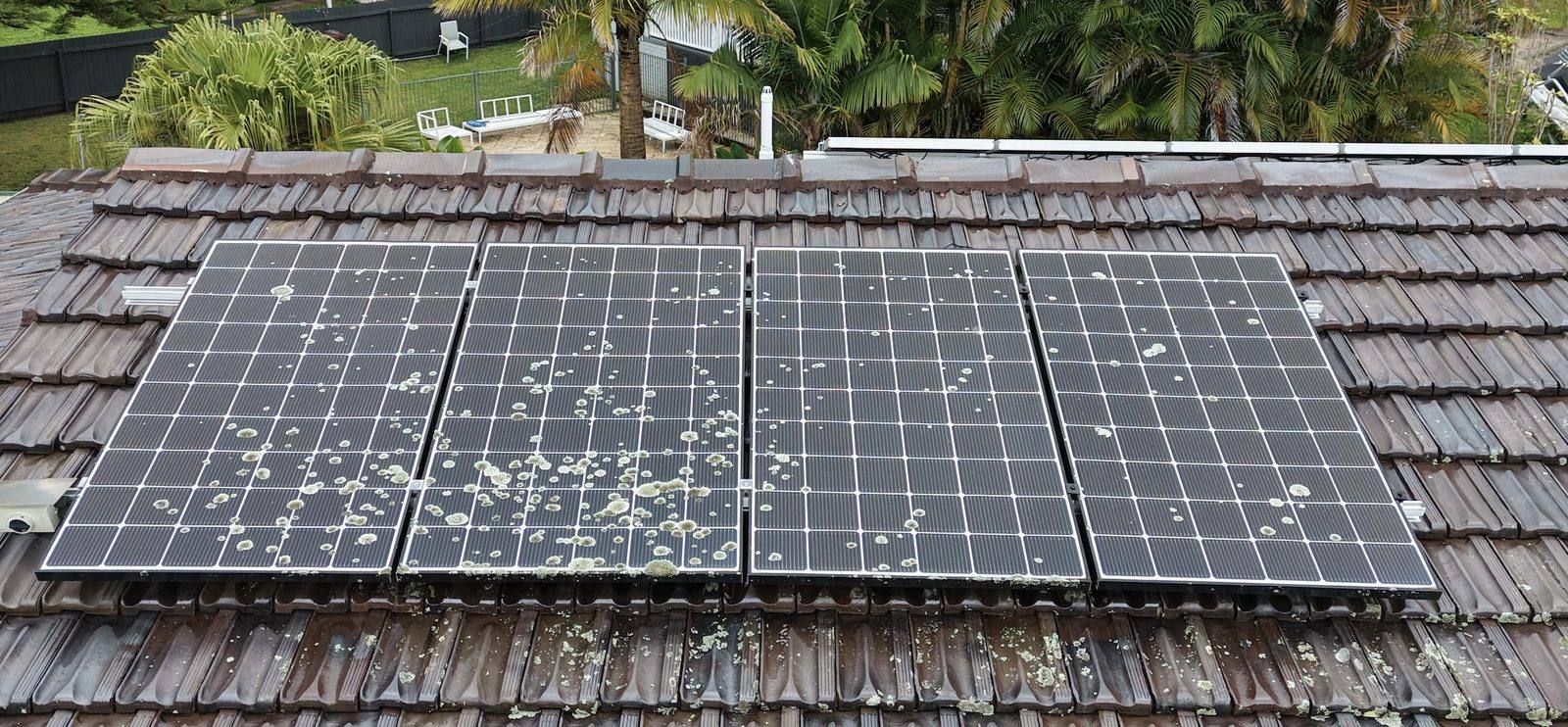
A dirty windscreen you notice straight away. Dirty solar panels? They just sit up there making a bit less power every day, and the only clue is an electricity bill that’s crept up for no obvious reason. In the middle of winter — shorter days, lower sun — every kilowatt-hour they can make matters most.
What’s actually sitting on your panels
On the Northern Beaches, the build-up is a layered thing. The base coat is a fine salt film — the same sea spray that hazes up coastal windows settles on panel glass and dries there. On top of that comes airborne dust and pollen (spring is brutal for it in the leafier suburbs), then the more stubborn stuff: bird droppings, leaf litter, and in shaded corners a slow creep of lichen and moss around the panel edges and frames.
Bird droppings are the worst offenders per square centimetre. A panel is a series of cells wired together, and a solid blob shading even one cell can drag down the output of the whole string — a small mess with an outsized cost.
What it’s costing you
The industry numbers are fairly consistent: everyday soiling typically costs 5–15% of output, and heavily soiled coastal panels can lose up to 25%. On a typical 6.6kW home system, even a 10% loss is roughly 800–900 kilowatt-hours a year — a couple of hundred dollars’ worth of power, gone without a trace. The sneaky part is that it happens gradually, so there’s no lightbulb moment. Most owners only find out when the panels are cleaned and the daily generation figure in their app suddenly jumps.
If your system has a monitoring app, there’s a quick check worth doing: compare this month’s best sunny-day output against the same time last year. A steady slide with no fault showing is very often just dirt.
“Won’t the rain wash them?”
It’s the most common question we get, and the honest answer is: not really. Rain rinses off loose dust, but it does nothing for salt film, baked-on droppings or lichen — and because rain itself carries dust, it often dries into a grimy film of its own, especially on panels installed at the shallow tilt most Sydney roofs have. If rain cleaned glass properly, none of us would ever wash a car.
Why the Beaches makes it worse
Three local factors stack the deck. Salt air is the big one — anywhere from Manly up to Palm Beach, panels wear the same coastal film as everything else on the house. Then there’s tree cover: homes around Frenchs Forest, Belrose and Terrey Hills deal with heavy pollen and leaf drop instead. And our abundant bird life — cockatoos, lorikeets, gulls near the water — treats a warm north-facing roof as prime real estate.
How a proper solar clean works
We clean panels the same way we clean glass — with our Advanced Ionic Zero System: water filtered down to zero dissolved minerals, applied with a soft brush on a water-fed pole. Pure water lifts the salt film and grime, then dries spot-free, because there’s nothing left in it to dry onto the glass. No detergents, no pressure washing, no abrasives — which matters, because harsh chemicals and high pressure can damage the anti-reflective coating and are exactly the things panel manufacturers list as warranty-voiding. In most cases we work from the ground or an access point, so nobody’s walking around your roof on wet glass.
How often — and how to make it cheap
For most Northern Beaches homes, once a year keeps panels close to full output. Right on the coast, under trees, or wherever birds have moved in, every six months is worth it. The smart money move is bundling: we’re already up at roof level for a gutter clean or a window clean, so adding the panels while we’re there keeps the extra cost small — usually well under what the recovered output is worth over the year.
Solar was a big investment, and it only pays you back when the sun can actually reach the cells. If you suspect yours are underperforming, grab a free, obligation-free quote — tell us your roof and system size and we’ll give you an honest steer on whether a clean is worth it for your place.